Rhubarb Diplomacy: 69 Allotment Border Skirmishes That Keep Britain Growing
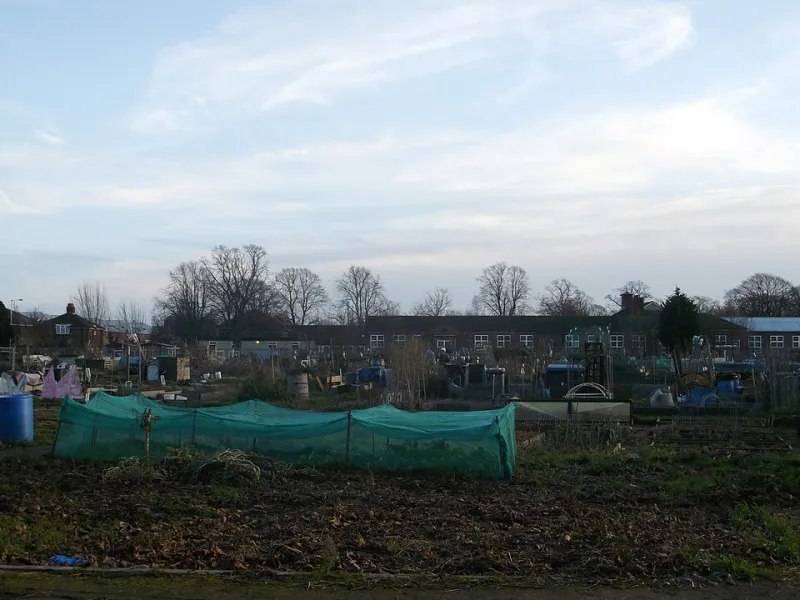
Photo: David Anstiss , CC BY-SA 2.0, via Wikimedia Commons
There is a moment, on almost every allotment site in Britain, when a grown adult in a fleece produces a tape measure from a shed and walks the line of a fence that nobody has ever officially drawn. It is a solemn ritual. It happens on a Sunday, always in November, usually in drizzle. And it is, in its way, the closest thing this country has to a border crisis.
An allotment plot is about 250 square metres of land with the full emotional apparatus of a nation-state: a constitution (the tenancy agreement), a judiciary (the committee), a press (the noticeboard), a standing army (the slugs) and a foreign policy (whether to say hello to the person at Number 14). Here, then, is a diplomatic dispatch from the front line — 69 small disputes that keep Britain growing.
The Shedline Accords
- A fence post that leans three degrees into next door's raspberries.
- The shed that grew a second storey "for ventilation purposes".
- A windbreak of leylandii that is legally a hedge and diplomatically an insult.
- A contested strip of grass recorded in the minutes as "the demilitarised zone, plot 43".
- A water butt overhanging the path by one inch of pure criminal intent.
- A pathway widened covertly, one wheelbarrow-load per fortnight, over a decade.
- Brick edging that has migrated eighteen inches since 2015 and shows no remorse.
- A compost heap that functions as a border, a heater and a threat.
- A gate hung to open onto the wrong plot, "by accident, since 2011".
- A thicket of brambles nobody planted and everybody claims.
- A gooseberry bush planted precisely on the line so that both sides are forced to negotiate.
Water, Hoses and the Law of the Tap
- A hosepipe that reaches exactly to the boundary and not a centimetre further.
- A shared standpipe governed by an unwritten rota and a very written grudge.
- The queue protocol at the tap: forty-litre cans, no eye contact, no small talk.
- A wheelie bin converted into a reservoir and addressed, in conversation, as "the reservoir".
- A summer hosepipe ban that revealed, retroactively, who had been filling up at five in the morning.
- Drip irrigation routed underground, and therefore, in the words of its owner, "not crossing anything".
- Puddle politics on the lowest plot on site, which floods and considers this leverage.
- A watering can monogrammed in nail varnish so that it comes home.
- The 2026 heatwave WhatsApp group that split into two mutually hostile groups within a week.
- A child's paddling pool repurposed as a lily pond, then as a diplomatic incident.
- A rain dance performed, sarcastically, in front of the committee.
- The annual tying-down of the butts: a ceremony of mutual forgiveness, lasting until March.
Rhubarb Espionage and the Marrow Wars
- Rhubarb crowns that creep under fences like a slow, delicious invasion force.
- A marrow left on a judge's bench with a note reading simply "consider this".
- A seed swap where the free seeds came with a full family tree of grievances.
- A prize parsnip measured with a surveyor's tape at dawn, before anyone else is up.
- Cabbage white butterflies allegedly released over a rival plot, unproven, unforgotten.
- A scarecrow dressed unmistakably in the site rep's actual clothes.
- A tomato trial where one entrant's flavour scores were counted twice by a sympathetic steward.
- A greenhouse with one pane glazed and the other ambitions.
- The unexplained vanishing of a single, perfect pumpkin on 30 October.
- A compost recipe guarded like a state secret, and roughly as smelly.
- A runner-bean teepee that blocks a view, and therefore, it is argued, a right.
- One raspberry cane planted as a boundary marker, now a full foreign policy.
Wildlife, Livestock and Non-Aggression Pacts
- A chicken kept quietly, adored universally, reported anonymously.
- Bees whose flight path over plot 8 was never formally agreed with plot 8.
- A cat with a documented preference for one neighbour's seed bed.
- Foxes used as an alibi for damage caused by humans with spades.
- A pond frog relocated without paperwork or apology.
- Pigeon netting that reads, to the plot opposite, as an act of aggression.
- A robin hand-fed by two households, and therefore a double agent.
- The rat treaty: nobody mentions the rat; everybody feeds the rat.
- A hedgehog house positioned to make a very specific point.
- Wasp-nest arbitration, convened in the tea hut, adjourned for biscuits.
- A dog that digs, and an owner who denies all known geography.
- A slow worm discovered during a boundary dig and immediately weaponised in moral terms.
The Committee and Its Courts
- A cultivation notice typed with a thesaurus and a long-held grudge.
- The six-month rule applied to a plot that has been a bonfire for three years.
- An AGM motion about the font size of the rules about the font size of notices.
- A treasurer's spreadsheet containing a column headed simply "vendettas".
- The site rep's clipboard, feared locally in the way others fear a warrant.
- Minutes that record what was said, then, in italics, what was meant.
- A sub-committee of three formed expressly to avoid involving a fourth person.
- An inspection walk timed to catch a rival mid-lunch.
- A vote on permitted shed colours that split two families and one marriage.
- The noticeboard's plastic wallet of shame, laminated for weather.
- A handwritten sign reading "PLEASE" followed by a full paragraph of subtext.
- Quorum achieved by telephoning retired plotholders before nine in the morning.
2026's Fresh Crop of Grievances
- A shed-mounted solar panel that outshines the committee's authority.
- A plot Instagram account that keeps posting photographs of other people's weeds.
- A no-dig convert who refuses, on principle, to be dug at.
- A drone flown over the site to gather evidence of alleged leylandii growth.
- The communal apple press and its booking system, currently in constitutional crisis.
- A memorial bench donated by a man who, in life, liked nobody.
- A wildflower strip that is either biodiversity or an excuse, depending on who is speaking.
- A car-share arrangement that curdled, via paperwork, into a boundary dispute.
- The Christmas mulled-wine evening, where the fence line was settled for a full ninety minutes.
- A rhubarb crumble brought to the January meeting as a peace offering, eaten with enthusiasm, peace politely declined.
Why the Fence Still Matters
The legal scaffolding is real enough: the Allotments Acts of 1922 and 1950 gave these plots their peculiar protections, and the six-month cultivation rule still carries weight in a committee room. But the day-to-day constitution of a British allotment site is unwritten, incremental and enforced by neighbourly sighing. Disputes are rarely about the three inches of soil in question. They are about recognition — about whether your years of digging, manuring and quiet obsession count for something on a site where everyone can see exactly what you did last summer.
Which is why the tape measures come out. Which is why the minutes get kept. Which is why, in 2026, the most hotly contested borders in this country are not at airports but between plot 12 and plot 13, where a gooseberry bush stands on the line like a tiny, thorny monument to the idea that a shared space needs shared rules.
And then, most years, someone brings a crumble to the January meeting, and the whole thing starts again — lovingly, pettishly, and in the general direction of spring.