Tarmac Laureates: 69 Roundabout Shrines That Made Their Villages Famous
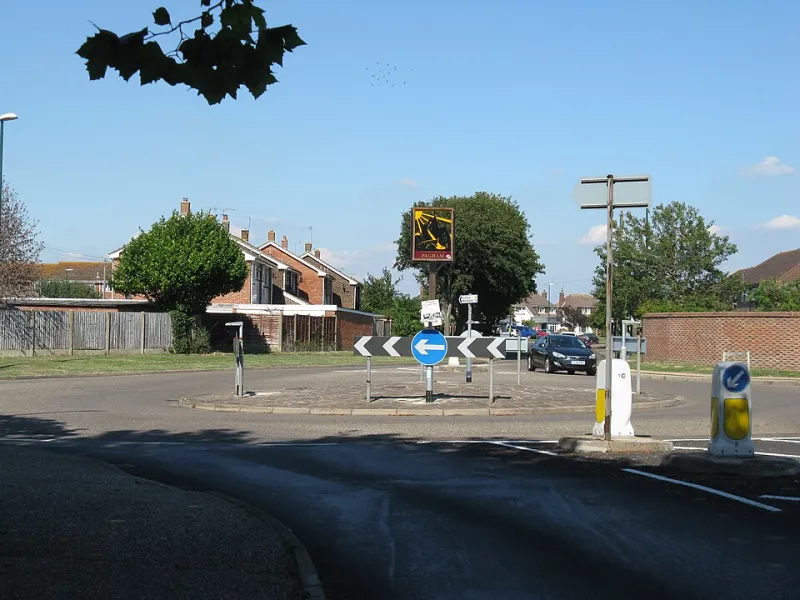
Photo: Dave Spicer , CC BY-SA 2.0, via Wikimedia Commons
A Nation of Tiny Stages
Britain has cathedrals, castles and coastal paths, but its most characterful civic monuments are often six feet of tarmac with a rock on top. In 2026 the traffic island is still a local celebrity: a roundabout garden, a memorial stone, a painted planter, a bench nobody can safely reach. It is where a village quietly announces that it has taste, a budget of forty pounds, and at least one volunteer who will not be thanked.
These are not grand landmarks. They are hyperlocal stages, maintained by people with secateurs and a laminator. And they matter, because a patch of kerb that somebody bothers to weed is a small declaration of belonging.
The First Twenty-Five Local Icons
-
The roundabout gnome who has been promoted to mayor. No election was held, but nobody disputes the result.
-
The memorial rock that gets more birthday cards than the vicar. It is a rock with a social life.
-
The painted planter that is technically a flowerbed and spiritually a monument. The marigolds are the congregation.
-
The traffic island known locally as 'the stage'. The Christmas choir performs there, weather and traffic permitting.
-
The mini lighthouse on the A-road that has never guided a boat. It guides people home after the pub.
-
The stone pig wearing a high-vis vest after dark. Safety first, swine second.
-
The island with a bench too small for two adults and one grievance. The grievance still sits there.
-
The daffodil crescent planted by a man who refuses to be thanked. He is thanked annually in the parish newsletter.
-
The roundabout where the council mows a heart shape every June. Romance, but with a strimmer.
-
The rock painted like a penguin, repainted whenever it offends someone. The penguin has a controversial legacy.
-
The island sign saying 'Welcome to the village' that faces the wrong way. It welcomes people leaving, which is optimistic.
-
The planter shaped like a narrowboat, complete with tiny chimney. The village had a canal once, and remembers.
-
The memorial bench on a traffic island that nobody can safely reach. It is a bench for the idea of sitting.
-
The roundabout sheep, now missing one ear and more beloved for it. The ear is part of local lore.
-
The island that hosts the annual snail race. The course is three inches and the drama is enormous.
-
The painted tyre stack that became a landmark and a planning dispute. Art is never simple.
-
The mini rockery with a sign reading 'Please do not climb the mountain'. The mountain is eighteen inches high.
-
The island Christmas tree that is a traffic cone with tinsel. It has more atmosphere than the town centre.
-
The roundabout where a plastic owl keeps pigeons and conspiracy theories away. The owl is not commenting.
-
The stone circle made of three bricks and a dream. Archaeologists have been informed. They are not coming.
-
The island with a time capsule nobody remembers burying. The mystery is now the point.
-
The planter maintained by a retired bus driver who treats it like a route. It runs daily, except in frost.
-
The roundabout with a tiny windmill that turns only when the wind is right. It is a diva.
-
The island memorial to a dog named Buster, who reportedly hated cars. Buster has the last laugh.
-
The painted bollard locals call 'the admiral'. Nobody knows why. Everybody salutes.
The Middle of the Roundabout
-
The hanging basket on a traffic island that requires a ladder and a committee. The committee meets in the pub.
-
The roundabout garden that won a Britain in Bloom certificate, now laminated to a fence. Fame is a sheet of A4.
-
The island where someone leaves a new plastic gnome every Bonfire Night. The gnome population is stable, roughly.
-
The rock with a face painted on it, known as 'Kevin'. Kevin has seen things and is not telling.
-
The planter shaped like a teapot, because the village had a pottery. The pottery closed; the teapot remains.
-
The roundabout where the council planted wildflowers and the village declared independence. The declaration was a sign.
-
The island with a tiny library box containing one thriller and a seed catalogue. Literature and leeks.
-
The memorial plaque to a pothole that was filled in 2019. It was a historic pothole, apparently.
-
The roundabout with a fake speed camera made of a cereal box and hope. It works on strangers and nobody else.
-
The island where the volunteer gardener has a rival volunteer gardener. The rivalry is conducted through mulch.
-
The painted stones spelling 'SLOW' that spell 'OWLS' after a vandal. The owls are now the official mascot.
-
The roundabout with a miniature Stonehenge made of kerbstones. The solstice is observed from the bus stop.
-
The island with a bench plaque reading 'Best view in town, if you stand'. The council has been asked to clarify.
-
The planter that is also an unofficial ashtray and an official argument. The argument is about the ashtray.
-
The roundabout tree decorated with lost gloves every winter. The gloves are not returned, but they are honoured.
-
The island with a small sign: 'Do not feed the pigeons. They have enough'. The pigeons disagree.
-
The memorial rose bush that blooms for one week and is discussed for fifty-one. The other weeks are anticipation.
-
The roundabout with a nervous-looking plastic heron. The heron is considering its options.
-
The island where a traffic cone has been painted gold and given a name. The name is Colin. It is always Colin.
-
The planter made from a bathtub, because the village is not made of money. It is made of daffodils instead.
-
The roundabout garden with a tiny scarecrow wearing a council jacket. The scarecrow has no planning powers, but looks official.
-
The island with a rock children call 'the spaceship'. It has never left the ground, but it has travelled in imagination.
-
The roundabout where the daffodils are planted in the shape of a smile. The smile is slightly wonky, which helps.
-
The island with a plaque thanking 'the unknown volunteer' who is definitely known. The village maintains the mystery for morale.
-
The planter that gets a fresh coat of paint whenever the parish council argues. The planter is the only winner.
Kerbside Celebrity
-
The roundabout with a tiny bridge over nothing. It is a bridge of principle.
-
The island where someone has placed a garden gnome reading a tiny newspaper. The gnome is better informed than most.
-
The memorial stone to the last tram, which no one remembers. The stone remembers for them.
-
The roundabout with a miniature drystone wall built by a man in a shed. It has no structural purpose and enormous civic value.
-
The island with a sign saying 'No ball games' next to a football. The football is evidence, not defiance.
-
The planter with a solar light that makes it look like a shrine to gardening. After dark, it is a shrine to gardening.
-
The roundabout where the grass is cut into a spiral and locals call it 'the maze'. No one has ever been lost, but they have tried.
-
The island with a single sunflower that became a news story. The sunflower did not give interviews.
-
The roundabout with a tiny flagpole and no flag, which is the point. It is a flagpole of quiet potential.
-
The planter shaped like a wellington boot, in honour of the weather. The weather has not thanked anyone.
-
The island with a rock painted as a strawberry, for reasons lost to time. The reasons are now part of the strawberry.
-
The roundabout where the volunteers hold an annual weeding party with flasks. The cake is the real attraction.
-
The island with a bench too narrow for the pigeons, who use it anyway. Pigeons do not read planning notices.
-
The planter with a laminated sign: 'These are not weeds, they are wildflowers'. The sign is losing the argument but winning the culture war.
-
The roundabout with a small stone owl stolen twice and returned once. The owl has a complicated relationship with freedom.
-
The island where the council painted a white line around a flower and called it a feature. Local government has a sense of humour, occasionally.
-
The roundabout with a tiny gate that leads nowhere and is always closed. It is the most respected gate in the village.
-
The planter that has outlasted three councils, two recessions and a bypass. It is the true local historian.
-
The traffic island that proves a village can be famous for six feet of kerb. In 2026, that is still a national achievement.
Six Feet of Belonging
Britain's tarmac celebrities are not ironic. They are sincere, slightly wonky and maintained by people who know that a roundabout is not just a roundabout: it is a front garden for everyone. The next time you wait at a junction, look at the planter, the rock, the tiny sign. Somebody made that. Somebody waters it. Somebody argues about it at the parish council. That is not a traffic island. That is a village with a stage.